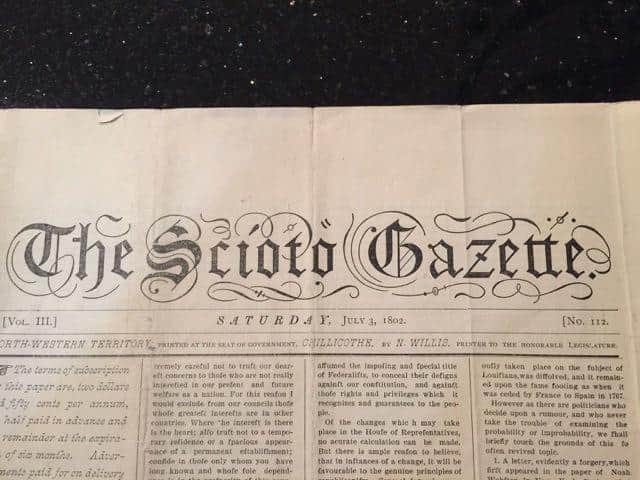
We wanted to share an article that was posted in the Chillicothe Gazette in January 2026.
Chillicothe Gazette Founded by Revolutionary Participant
By Destiny Torres
CHILLICOTHE – On the night of Dec. 16, 1773, more than 100 colonists dressed up in native American clothing and swarmed British ships in the Boston harbor. Together, these settlers dumped approximately 340 chests of tea in the water to protest taxation.
Among them was Nathaniel Willis, an 18-year-old printer’s apprentice working in Boston. Through this name might not sound familiar to many, he has made an imprint on the Ross County community that has lasted more than two centuries. He founded the Chillicothe Gazette.
Drew Muser, owner of The Willis-James Bed and Breakfast, which was originally Willis’ home, has done extensive research on the matter. “I spent a lot of time in Boston at the Massachusetts Historical Society,” Musser said. “We know he was a participant in the Boston Tea Party when he was a kid. But through various records, I think I’ve come to a real understanding of this man.” According to Musser, Willis grew up in the north end of Boston, and his father was a sailmaker. “He was obviously a Son of Liberty. Being in that area, him being an apprentice in a newspaper shop. All these newspaper boys were Liberty Boys, sending secret messages from the Committees of Safety and stuff around Boston during that time,” Musser said.
While visiting Boston, Musser learned Willis lived right around the corner from where Paul Revere lived. At some point, Willis began an apprenticeship at the same print shop where Benjamin Franklin worked at years prior; this was Willis’ start in the world of print.
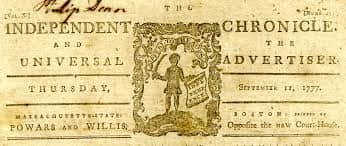
Musser said after the British evacuated Boston during the revolution, Willis returned to the city, where he and a partner bought a newspaper called the New England Chronicle and later changed the name to Independent Chronicle.
“It was one of the most prominent newspapers during the American Revolution,” Musser said. “Willis sold the Independent Chronicle to a group of guys after the Revolutionary War and he went to work with his partner at another paper.”
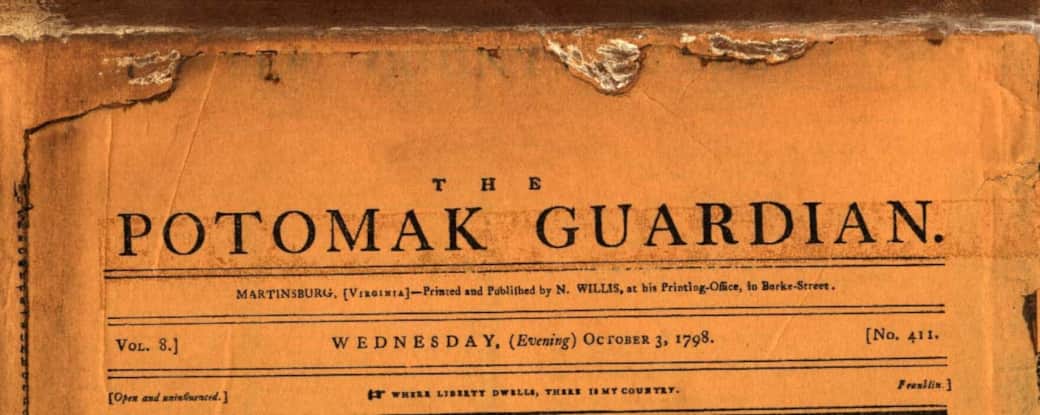
Though there are no documents, it is assumed by many, including Musser, that Willis’ wife died an that is when he left Boston and moved to Virginia, a state that was initially said to hold the nation’s capital. “He went there [Virginia] and started a little newspaper called Willis’ Gazette.” Musser said. “I think he wanted to be the first newspaper in the new capital, which is why he went there.” But when the capital shifted to Potomac, which would eventually turn into what is current day Washington D.C., Willis moved down to Winchester County, Virginia and operated another paper called the Potomac Guardian and the Berkely Advertiser, which was the first newspaper in the state of West Virginia. “It was an anti-federalist paper,” Musser said. “He was anti-federalist, se he didn’t like John Adams and policies of the Federalists. He was more pro-Jeffersonian and part of the Jeffersonian Republic contingent.”
According to Musser, a lot of men who settled there, like Thomas Worthington and Edward Tiffin were all personal friends of Thomas Jefferson, so he assumes Willis knew him. Bu the paper did not las long, as he was “muscled out” of the area. “They ransacked his print shop and threatened his farm and his family,” Musser said. “He married a slave holder’s daughter in Virginia, Mary Cartmell, and they had a couple of kids in Virginia. He moved his family here to Chillicothe, at the persuasion of Worthington, who owned this piece of property and sold it to Willis.” Musser said when he moved to Chillicothe, he bought a paper that had already existed here, and on April 25, 1800, the first edition of the paper, eventually known as the Chillicothe Gazette, was printed. “He retired from printing around 1810, 1812 and retired to Bainbridge,” Musser said.
According to Chillicothe Gazette archives, after Willis sold the newspaper in the early 1800s, he bought farmland in the southern part of Pike County and owned Willis’s Tavern Stand. He eventually sold that property in 1829. According to archives, Willis died on April 1, 1831. He was assumed to be buried in a field near his home in Pike County. “There’s a tombstone in the Bainbridge Cemetery that was put there back in the eighties by the Daughters of the American Revolution,” Musser said. “Through a process, they found where his original gravestone was located, but it was not where his body was located.” Musser said the original gravestone was moved to the Bainbridge Cemetery but was eventually moved back to its final resting spot. Though his body was never found, people can visit a gravestone in Bainbridge with a placard that tells the world of his mark on history during the Boston Tea Party.